
There are more ways than ever to learn about sex or experience pleasure alone. Devices are easy to buy, online content is endless and AI companions can respond at any hour. But access to information is not the same as comfort with your own body, and private pleasure is not the same as relating to another person.
Relationship research and professional guidance describe several recurring patterns: adults who feel comfortable alone but become anxious with a partner, couples who struggle to initiate touch, and partners who find sustained, non-demanding affection unexpectedly difficult.
Desire may not have disappeared; the greater difficulty can be what happens between two people.
These observations are educational, not a diagnosis or a substitute for individual care.
Why younger adults can struggle with partnered intimacy
Published research and professional discussion increasingly include people in their twenties alongside older couples. They are also more likely to arrive with someone else. A partner may accompany them, which can be useful; sometimes parents or extended family become involved too.
That creates a contradiction. A person may be 25 or 30, yet their family still manages their work, marriage and now their intimate life. Concern can easily become pressure. Therapy, however, depends on the client's own willingness to participate.
One man in his late twenties had been married for several years without being able to have comfortable partnered sex. His family assumed the problem belonged to his wife or blamed attraction. In therapy, it became clear that his earlier “experience” had also been unsuccessful. He was dealing with erectile difficulties and shame, but expected his wife to take notes, organise exercises and remind him what to do. Even his parents called the therapist to ask her to push him.
The difficulty was not only physical. He had not taken ownership of his own care. A partner or therapist can support change, but neither can practise on somebody else's behalf.
Other young clients arrive with very little reliable body knowledge despite growing up online. One woman, who had experienced bullying and harassment when she was younger, had learned to interpret closeness as a threat. She had no trusted person with whom to discuss ordinary questions about hygiene, discharge or when to see a clinician.
Her therapy began with accurate information, body awareness and choice. The goal was not to push her into a relationship. It was to help her feel less frightened and more able to decide what she wanted.
Desire has not disappeared; partnered desire has become harder
Public discussion often treats declining sexual frequency as proof that young people have lost interest. Research suggests something more nuanced. A person may say that partnered sex has become rare while their solo sexual activity has not changed.
Partnership carries a higher emotional cost. It requires time, preparation, communication and attention to another person's state. Solo pleasure is available without negotiation. When people are tired, busy or accustomed to immediate digital stimulation, the easier option can become the default.
That is not the whole explanation. Many couples withdraw after repeated disappointment. One awkward experience may be manageable. Several can create shame, avoidance and fear of another “failure.” Eventually, neither person initiates.
Online sexual material can also distort the expected sequence. Short clips often remove the beginning, the pauses and the communication. They present fast escalation as though it were spontaneous and universal. Real people then wonder why their own bodies do not move through a clean, predictable script.
When closeness becomes a task
Some people prepare alone until they believe they are in a perfect physical state, then summon their partner. The partner waits nearby as if the encounter cannot begin until a technical requirement has been met.
Couples trying to conceive can feel this especially strongly. A calendar identifies a fertile window, and intimacy becomes a scheduled reproductive task. The goal is understandable, but pressure can crowd out pleasure and emotional presence.
Performance anxiety often appears as comparison: Am I better than a former partner? Is this happening often enough? Am I normal? Those questions create standards that may have little to do with the two people involved.
There is no universal number of times a couple should have sex. The more useful questions are whether both partners feel safe, heard and free to say yes, no or not now—and whether one person's needs are being consistently ignored.
Desire also rarely arrives for both people at exactly the same moment. Intimacy is closer to a partner dance: one person signals, the other responds, and both adjust to each other's pace. If neither speaks, each may interpret the other's silence as disinterest and gradually stop trying.
Private pleasure has more outlets
Attitudes toward sexual devices have become more open. Clients now discuss them more openly, including women who once felt they had to hide any sign of sexual agency.
A device and a human partner need not be treated as opposites. A tool can be used alone or together. It can provide stimulation, but it cannot automatically supply trust, negotiation, repair or the experience of being genuinely answered by another person.
The same distinction applies to AI companionship. A system can be available and responsive in ways a tired human cannot. It may offer emotional comfort. Yet a real relationship includes difference, inconvenience and surprise. Those are not merely defects; they are part of learning how to care for someone who has a separate mind and body.
A long relationship does not need to stay at boiling point
Physical attraction matters, but it rarely remains at the intensity of a new romance. One useful comparison is that good long-term sex can become like warm water.
At the beginning, everything may feel close to boiling. Over time, a secure relationship usually settles into a comfortable temperature. It does not need constant heat, but it should not be allowed to become completely cold. Trust and safety form the base; novelty can create occasional new peaks.
The quality of a couple's intimate life is connected to the rest of their life. If they share no pleasure, curiosity or kindness outside the bedroom, technique alone is unlikely to restore closeness. That is why sex therapy does not treat a body part in isolation. It may involve health, personality, family history, workload, shame and the way two independent people live together.
When is it worth getting professional help?
The deciding factor is not frequency. It is distress. If both people are comfortable with limited or no sexual activity, they do not need to manufacture a problem because somebody else's relationship looks different. If anxiety, pain, erectile difficulty, low desire or conflict is affecting wellbeing or the relationship, it is worth speaking to an appropriately qualified professional.
A clinician may first assess physical causes, medication effects or pain. A qualified therapist can help with fear, communication and relationship patterns. The right route depends on the concern, and sometimes both forms of support are useful.
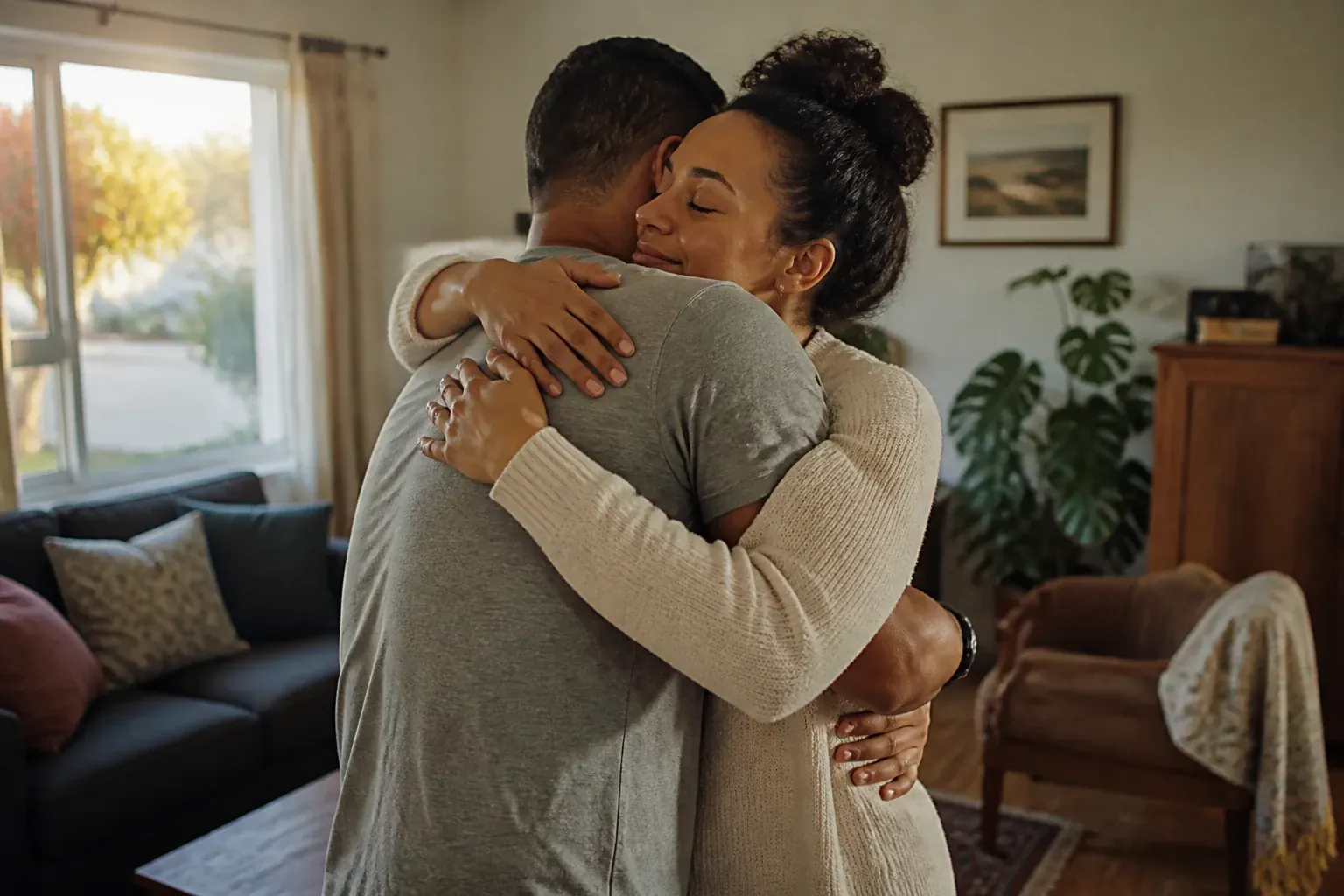
Some qualified therapists begin with a very small exercise: a sustained embrace with no demand that it lead anywhere. Couples who assume this will be easy sometimes pull away quickly because they feel hot, awkward or exposed. They may be used to a ritual kiss before work, but not to resting their attention on each other.
They start with a minute and build gradually. Some eventually cry, realising how long it has been since they held each other without rushing toward the next task.
The exercise is not really about learning a position. It is about learning to let your attention settle—not only in yourself, but with another person.
Consent remains essential in every relationship. No therapy exercise should require a person to accept touch they do not want. Persistent pain, coercion or fear deserves prompt professional support; an unsafe relationship is not a communication exercise.
Editorial note: Intimacy is not a performance score. If closeness has become difficult, begin with safety, honest conversation and small moments of attention that carry no demand to go further. Persistent pain, fear or distress deserves qualified professional support.
Editorial method, sources and review
How this article was prepared
The article synthesises public-health guidance and peer-reviewed relationship research. Therapy-room examples are composite educational scenarios created to explain recurring patterns; they are not transcripts or identifiable client histories.
Evidence review completed 3 September 2026 using WHO guidance and peer-reviewed professional literature. No named clinician has individually reviewed this article.
Sources
- World Health Organization: defining sexual healthRights-based context for wellbeing, consent and respectful relationships.
- European Society for Sexual Medicine position statement on sexual desire discrepancyProfessional evidence on differences in desire within couples.
- Sexual communication and sexual function: meta-analysisPeer-reviewed evidence connecting communication and sexual wellbeing.
- Partner communication and wellbeing in couples affected by vulvodyniaResearch context for supportive communication when pain or distress is present.
See our editorial standards. To report a factual or safety concern, use the official support route and include this page URL.